Knowledge and source foundations
can be made clearer so SOPs, company knowledge, service knowledge, client context, standards and examples have more authoritative homes.
.webp)
 Agency EnabledAIAgency EnabledAI
Agency Replatforming means redesigning how an existing agency operates so its knowledge, workflows, people, systems and AI work together.
Giving people better AI tools is not the same as changing how the agency itself works. Individual adoption can happen quickly while the operating model underneath it remains fragmented, undocumented and dependent on individual habits.
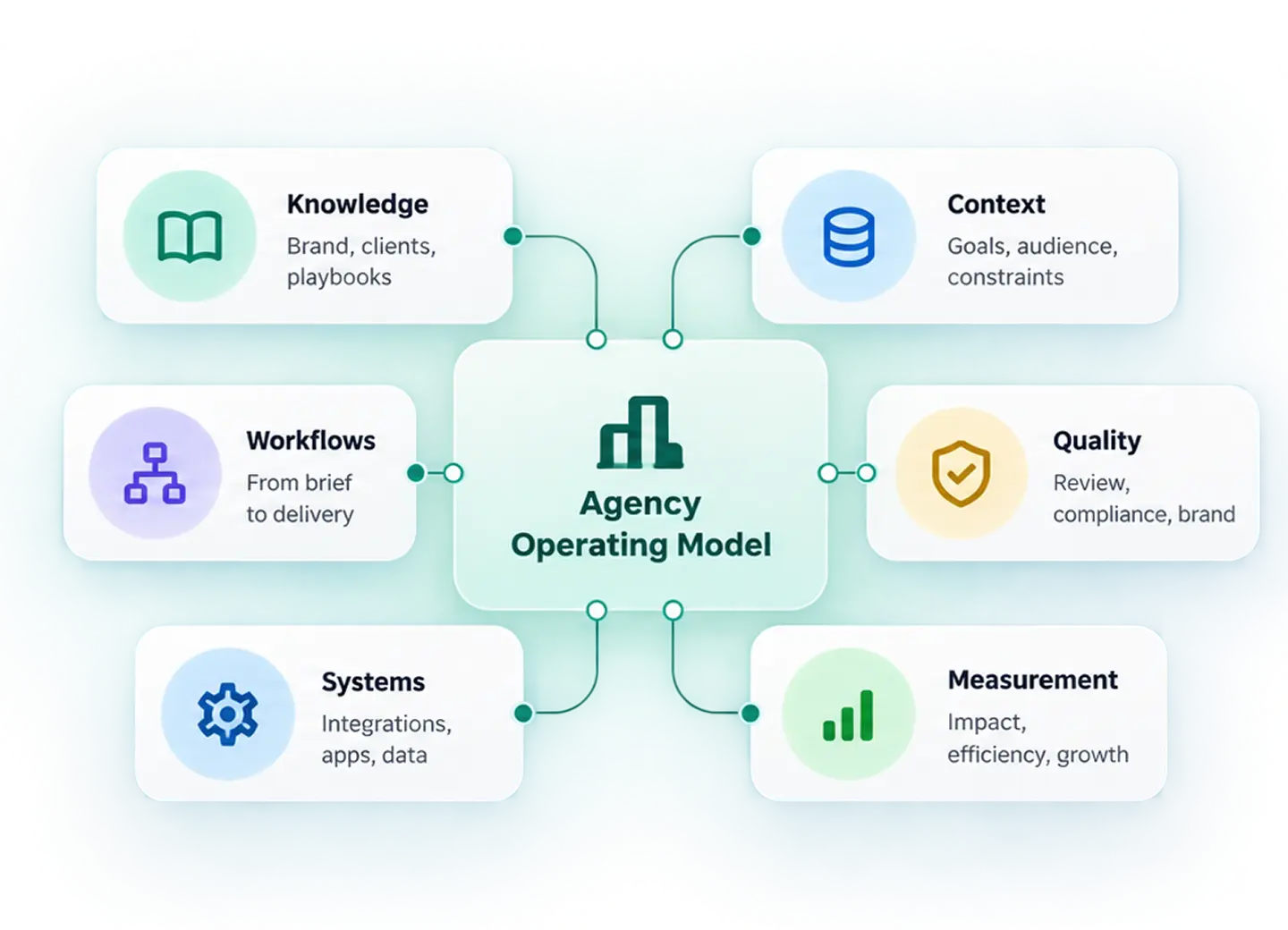
Shared knowledge
Connected systems
Reusable context
Human accountability
Clearer workflows
Way to measure what changed
Define controls
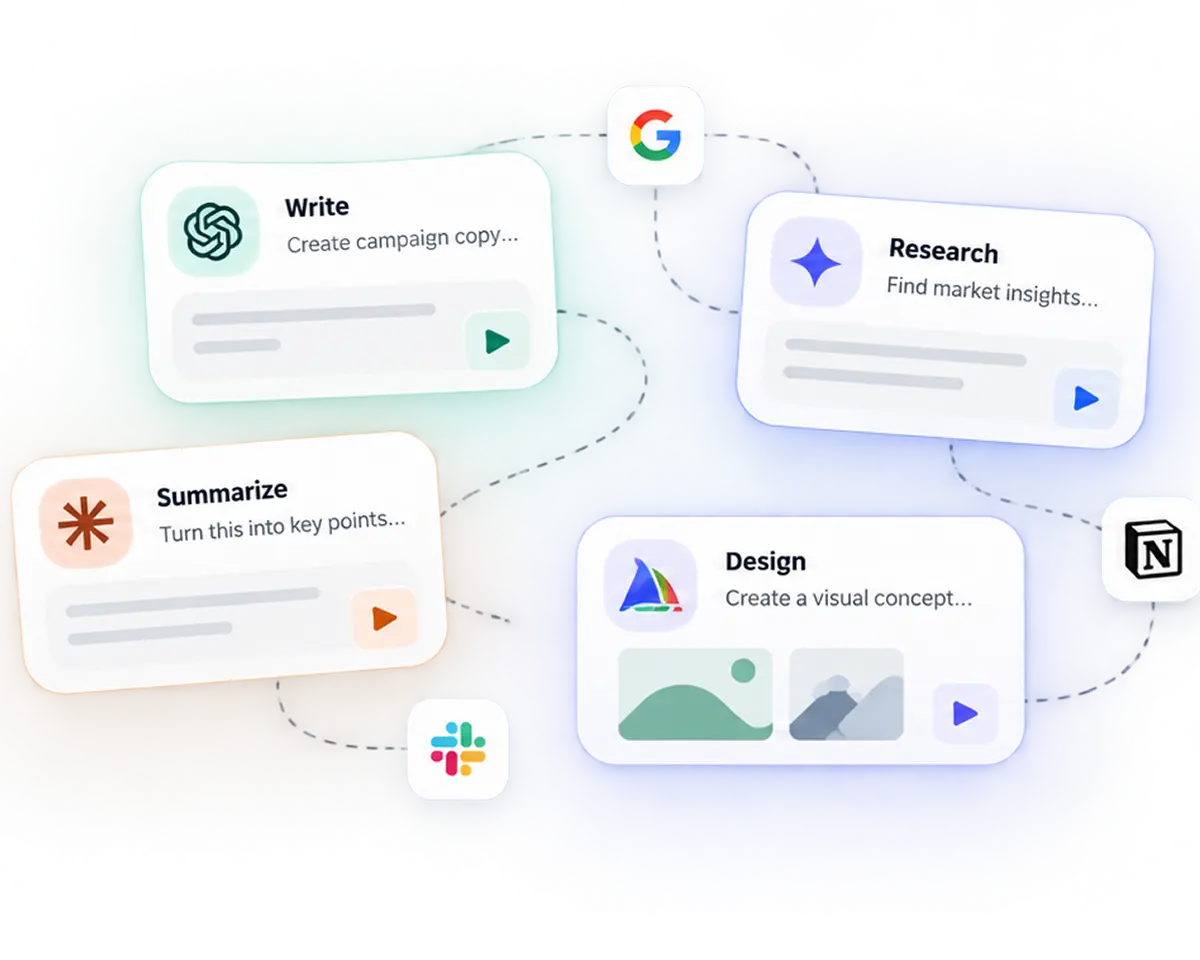
An agency can have ChatGPT, Claude, automation tools and AI features across its software stack without having an AI-enabled operating model.
The constraint is often not access to another tool. It is the environment the tool has to work inside. If company knowledge is scattered, client context lives in individual heads, workflows are inconsistent, ownership is unclear, permissions are undefined and QA happens differently from person to person, AI is being added to an operating system that was never designed for it.
That can leave each person rebuilding context, inventing their own prompting habits, deciding their own quality threshold and finding their own way around gaps in the process. The agency may be using AI while still depending on the same underlying operating assumptions it had before AI was available.
Personal AI use is useful, but organizational capability requires more than individual skill.
It needs a way to make approved company, service and client context available where work happens. It needs workflows that make ownership, handoffs, exceptions and review points explicit. It needs governance around access and sensitive information. It needs QA and human control for consequential work. It needs training so the operating model is adopted across roles, not just by the most enthusiastic users. And it needs measurement so leadership can distinguish an interesting experiment from a durable operating change.
That is the shift Agency Replatforming is designed to support: from people using AI independently to an agency deliberately changing how work is organized around AI.
.webp)
The exact scope depends on the Audit, but the work can reach across the connected operating architecture behind client delivery.
can be made clearer so SOPs, company knowledge, service knowledge, client context, standards and examples have more authoritative homes.
can be structured so approved information is easier to use consistently rather than reconstructed in every prompt or conversation.
.webp)
can be redesigned around the right combination of human judgment, AI assistance and controlled automation, with explicit ownership, handoffs, review points and exceptions.
.webp)
can be connected where there is a real operating case. Governance, permissions and data boundaries can be defined. QA can be designed into AI-supported work instead of added informally at the end. Training, adoption and measurement can become part of the operating model instead of afterthoughts.
.webp)
These are connected parts of one system. AEA does not treat them as eight unrelated products or assume every agency needs the same changes.
It's not a technology-first mandate. Instead, it's a structured approach to evidence, operating model, and AI enablement—done in a way that preserves what already works.
It's not just moving AI assets into place without a clear operating model, governance, or evidence of what will actually improve.
It's not a mandate to replace every existing tool. A sound system can be retained if it still fits the operating model.
It's not automating every workflow. Unstable or poorly defined work should not be automated simply because automation is technically possible.
It's not replacing employees with agents as an objective. Human judgment, QA, ownership, and accountability remain part of the design.
It establishes an evidence-based foundation for AI transformation.
The Audit evaluates how the agency currently operates across the areas that matter to an AI-enabled operating model, validates the evidence behind the assessment, identifies material gaps and risks, maps priorities, and develops the recommended Replatforming roadmap and scope.
.webp)
Strong foundations can be retained. Weak foundations can be addressed before downstream work depends on them. Some opportunities may be deferred rather than forced into the first Program.
.webp)
The Audit also confirms the final Program scope and price. For standard engagements, the public estimate comes before the Audit based on submitted information; the Audit validates the actual operating conditions before final scope and pricing are confirmed.
If your team is already using AI, the next step is not automatically another app. It is understanding which parts of the agency need to work differently for AI to become an organizational capability rather than a collection of individual habits.
Start with the Audit to validate the current state, identify what should change first and understand the likely Program investment.